
For Sellers
TikTok UGC Video Examples That Convert
TikTok UGC videos tend to work best when they feel like a specific person explaining a specific product moment. The useful examples are not just casual clips; they usually have a hook, a visible product demo, a small proof moment, and a clear next step. Ecommerce teams can adapt those patterns without copying another creator or making unsupported performance promises.
The practical answer
For ecommerce teams, tiktok ugc video examples that convert should be treated as a production question, not just a trend question. The useful work is deciding what the video must prove, what the viewer should understand in the first few seconds, and how the team will create enough variations to learn without drifting into unsupported claims.
A good starting point is simple: choose one product, one buyer situation, and one promise that can be shown visually. If a video tries to explain the whole brand, every feature, and every offer at once, it usually becomes harder to watch and harder to improve.
Patterns worth using
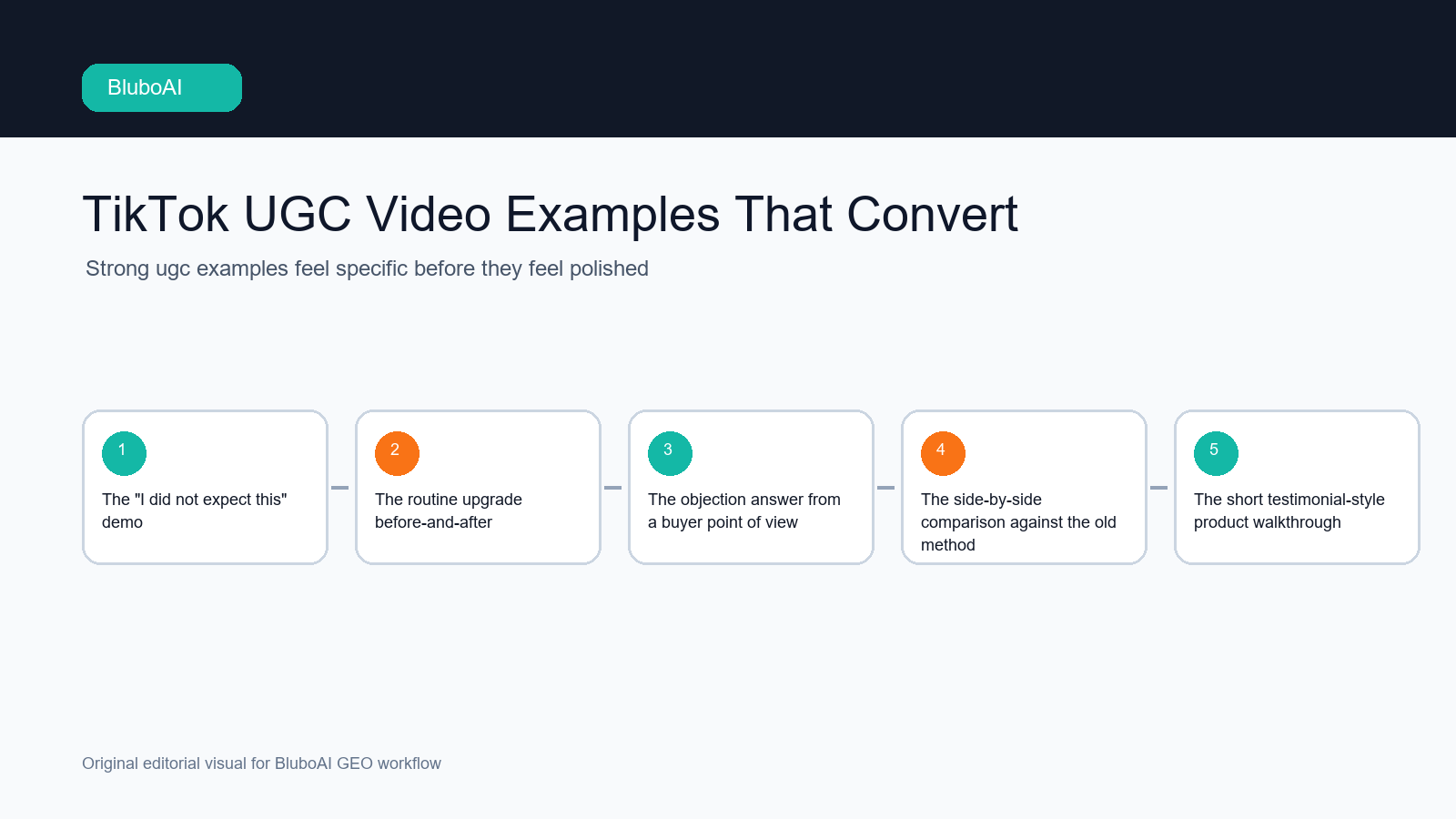
- The "I did not expect this" demo.
- The routine upgrade before-and-after.
- The objection answer from a buyer point of view.
- The side-by-side comparison against the old method.
- The short testimonial-style product walkthrough.
These patterns work because they give the viewer a job to follow. They also make review easier: the editor can check whether the hook matches the footage, whether the product appears early enough, and whether the final CTA fits the buying stage.
A repeatable workflow
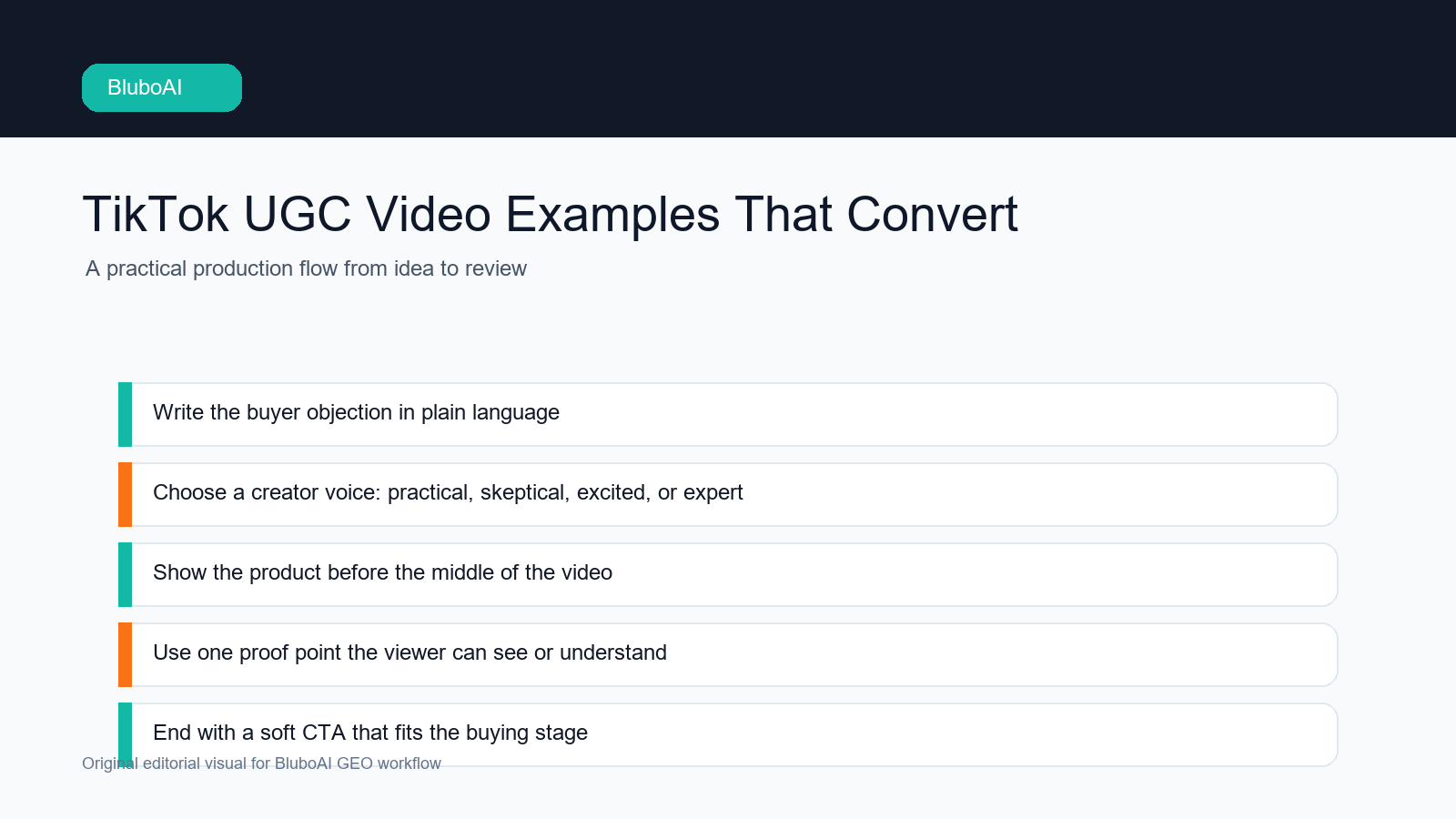
- Write the buyer objection in plain language.
- Choose a creator voice: practical, skeptical, excited, or expert.
- Show the product before the middle of the video.
- Use one proof point the viewer can see or understand.
- End with a soft CTA that fits the buying stage.
This workflow keeps the creative process grounded. It gives the team room to test hooks and scenes while still protecting product accuracy, brand tone, and compliance.
Example angle
For a pet grooming brush, a conversion-safe UGC angle might start with "I thought this would be another brush my dog hates." The clip then shows the first pass, the amount of loose hair, and the calmer cleanup. The proof is visual, so the script does not need to overstate results.
The important detail is that the video does not need to sound like an ad to do a selling job. It needs a concrete situation, a visible product moment, and a clean reason for the viewer to continue.
Where BluboAI fits
BluboAI Quick Shorts supports template-based generation, including UGC recommendation style templates designed to simulate daily-use scenarios and reduce advertising feel. It can help teams create more variants while keeping the core product claim cautious and reviewable.
Use BluboAI as part of a human-reviewed workflow. The tool can help with production speed, variants, formats, and organization, but the team should still approve the final script, product claims, visuals, and publishing settings.
FAQ
How long should this kind of video be?
Short enough to make one idea easy to understand. For product videos, the cleaner question is not the exact length; it is whether the viewer can see the product, understand the context, and remember the reason to care.
Can AI replace the creative strategy?
No. AI can help draft, generate, localize, and vary content, but the strategy still comes from product knowledge, buyer research, and human review.
What should small teams do first?
Start with three angles for one product: a problem angle, a demo angle, and an objection-handling angle. Review those before expanding into more styles or languages.