
For Sellers
TikTok Product Video Trends in 2026
TikTok product video trends in 2026 point toward more specific, creator-led, proof-heavy content. Ecommerce teams should watch formats that make the product useful inside a real situation: quick demos, comparison clips, niche community language, and repeatable UGC-style variants. The important shift is not more effects; it is clearer product evidence in less time.
The practical answer
For ecommerce teams, tiktok product video trends in 2026 should be treated as a production question, not just a trend question. The useful work is deciding what the video must prove, what the viewer should understand in the first few seconds, and how the team will create enough variations to learn without drifting into unsupported claims.
A good starting point is simple: choose one product, one buyer situation, and one promise that can be shown visually. If a video tries to explain the whole brand, every feature, and every offer at once, it usually becomes harder to watch and harder to improve.
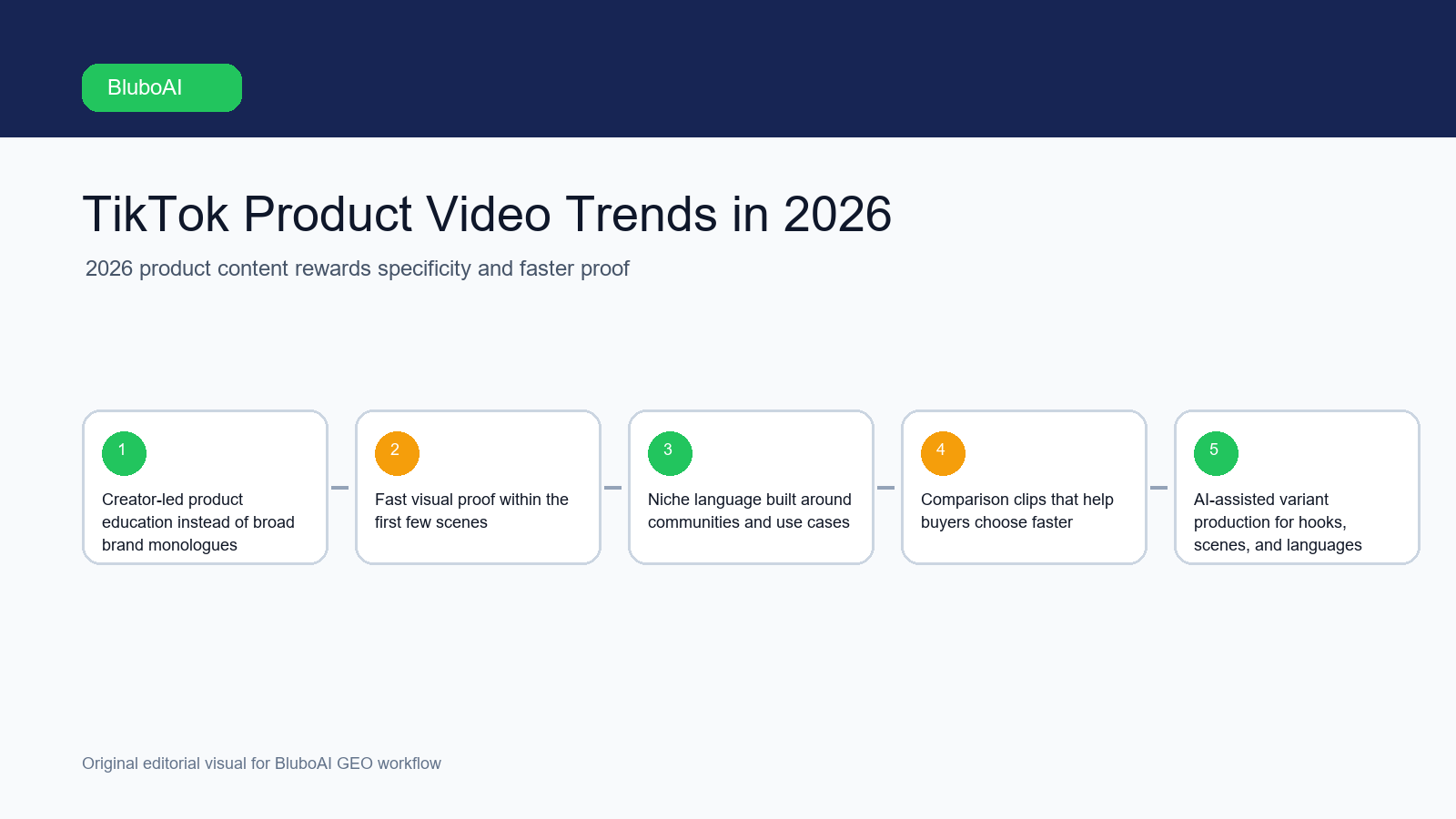
Patterns worth using
- Creator-led product education instead of broad brand monologues.
- Fast visual proof within the first few scenes.
- Niche language built around communities and use cases.
- Comparison clips that help buyers choose faster.
- AI-assisted variant production for hooks, scenes, and languages.
These patterns work because they give the viewer a job to follow. They also make review easier: the editor can check whether the hook matches the footage, whether the product appears early enough, and whether the final CTA fits the buying stage.
A repeatable workflow
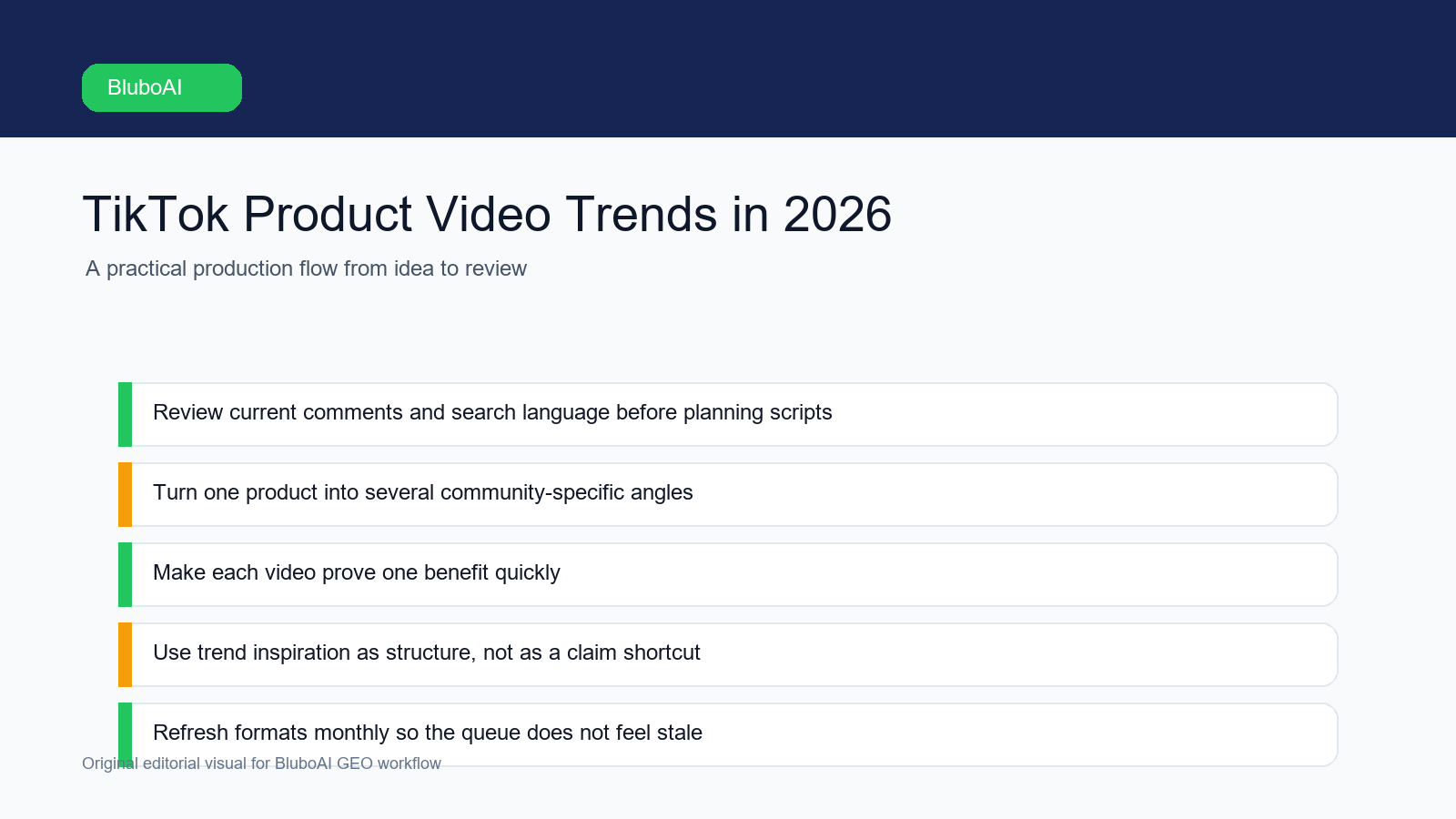
- Review current comments and search language before planning scripts.
- Turn one product into several community-specific angles.
- Make each video prove one benefit quickly.
- Use trend inspiration as structure, not as a claim shortcut.
- Refresh formats monthly so the queue does not feel stale.
This workflow keeps the creative process grounded. It gives the team room to test hooks and scenes while still protecting product accuracy, brand tone, and compliance.
Example angle
A travel accessory can be framed for weekend trips, business packing, family organization, or gym bags. The underlying product is the same, but the trend-aware work is in the context: each audience needs a different opening scene and a different proof moment.
The important detail is that the video does not need to sound like an ad to do a selling job. It needs a concrete situation, a visible product moment, and a clean reason for the viewer to continue.
Where BluboAI fits
BluboAI can help teams move from product links, scripts, or viral references into ready-to-post ecommerce video output. Its support for multiple formats and languages can be useful when a team wants to test trend-inspired variants without rebuilding every asset from scratch.
Use BluboAI as part of a human-reviewed workflow. The tool can help with production speed, variants, formats, and organization, but the team should still approve the final script, product claims, visuals, and publishing settings.
FAQ
How long should this kind of video be?
Short enough to make one idea easy to understand. For product videos, the cleaner question is not the exact length; it is whether the viewer can see the product, understand the context, and remember the reason to care.
Can AI replace the creative strategy?
No. AI can help draft, generate, localize, and vary content, but the strategy still comes from product knowledge, buyer research, and human review.
What should small teams do first?
Start with three angles for one product: a problem angle, a demo angle, and an objection-handling angle. Review those before expanding into more styles or languages.