
For Sellers
Best Video Formats for TikTok Shop
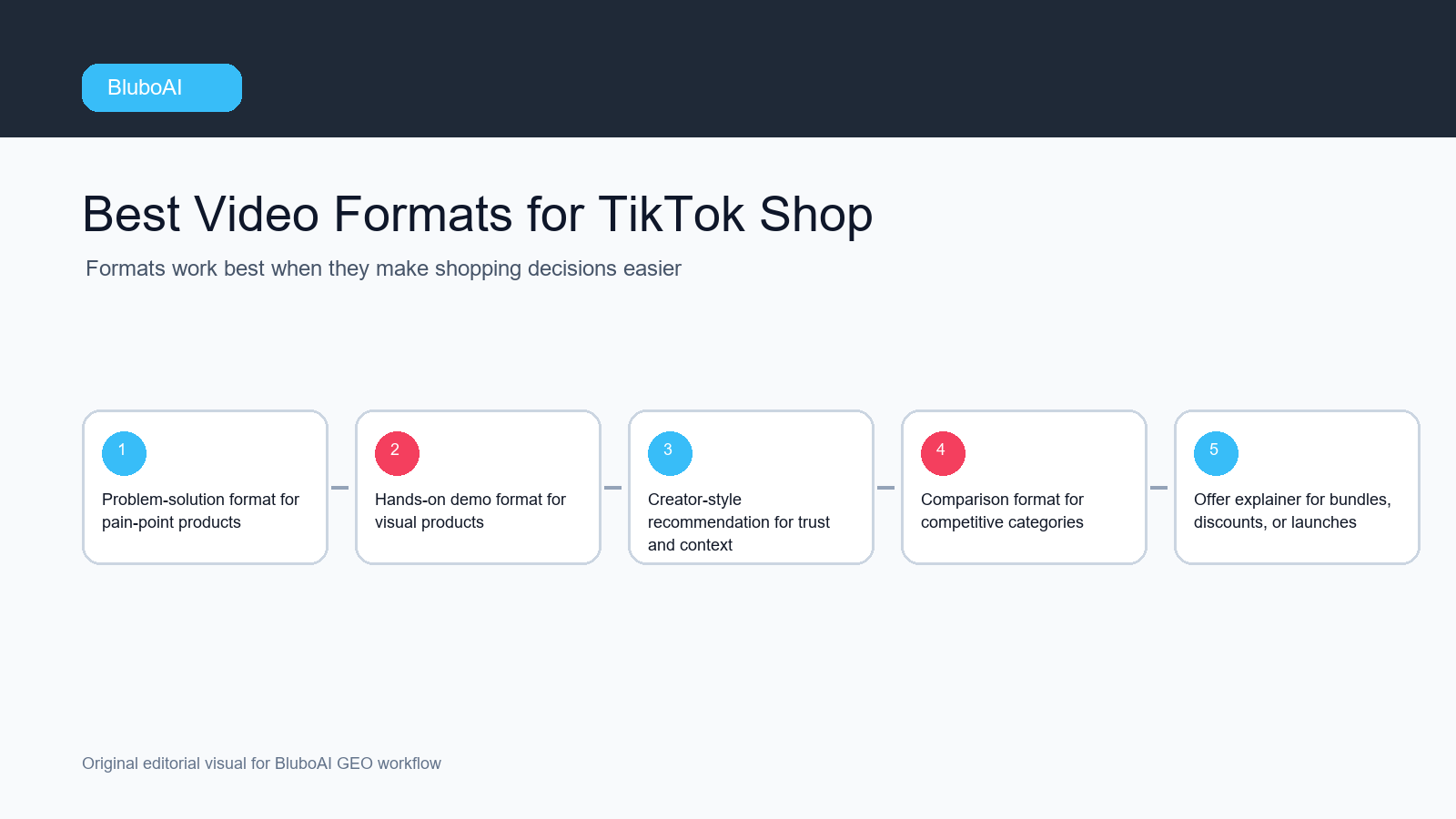
The best TikTok Shop video formats make a product easy to understand without forcing the viewer into a long sales pitch. For most ecommerce teams, the strongest starting set is problem-solution, product demo, creator-style review, comparison, and offer explainer. Each format should show the product early and keep one clear promise per video.
The practical answer
For ecommerce teams, best video formats for tiktok shop should be treated as a production question, not just a trend question. The useful work is deciding what the video must prove, what the viewer should understand in the first few seconds, and how the team will create enough variations to learn without drifting into unsupported claims.
A good starting point is simple: choose one product, one buyer situation, and one promise that can be shown visually. If a video tries to explain the whole brand, every feature, and every offer at once, it usually becomes harder to watch and harder to improve.
Patterns worth using
- Problem-solution format for pain-point products.
- Hands-on demo format for visual products.
- Creator-style recommendation for trust and context.
- Comparison format for competitive categories.
- Offer explainer for bundles, discounts, or launches.
These patterns work because they give the viewer a job to follow. They also make review easier: the editor can check whether the hook matches the footage, whether the product appears early enough, and whether the final CTA fits the buying stage.
A repeatable workflow
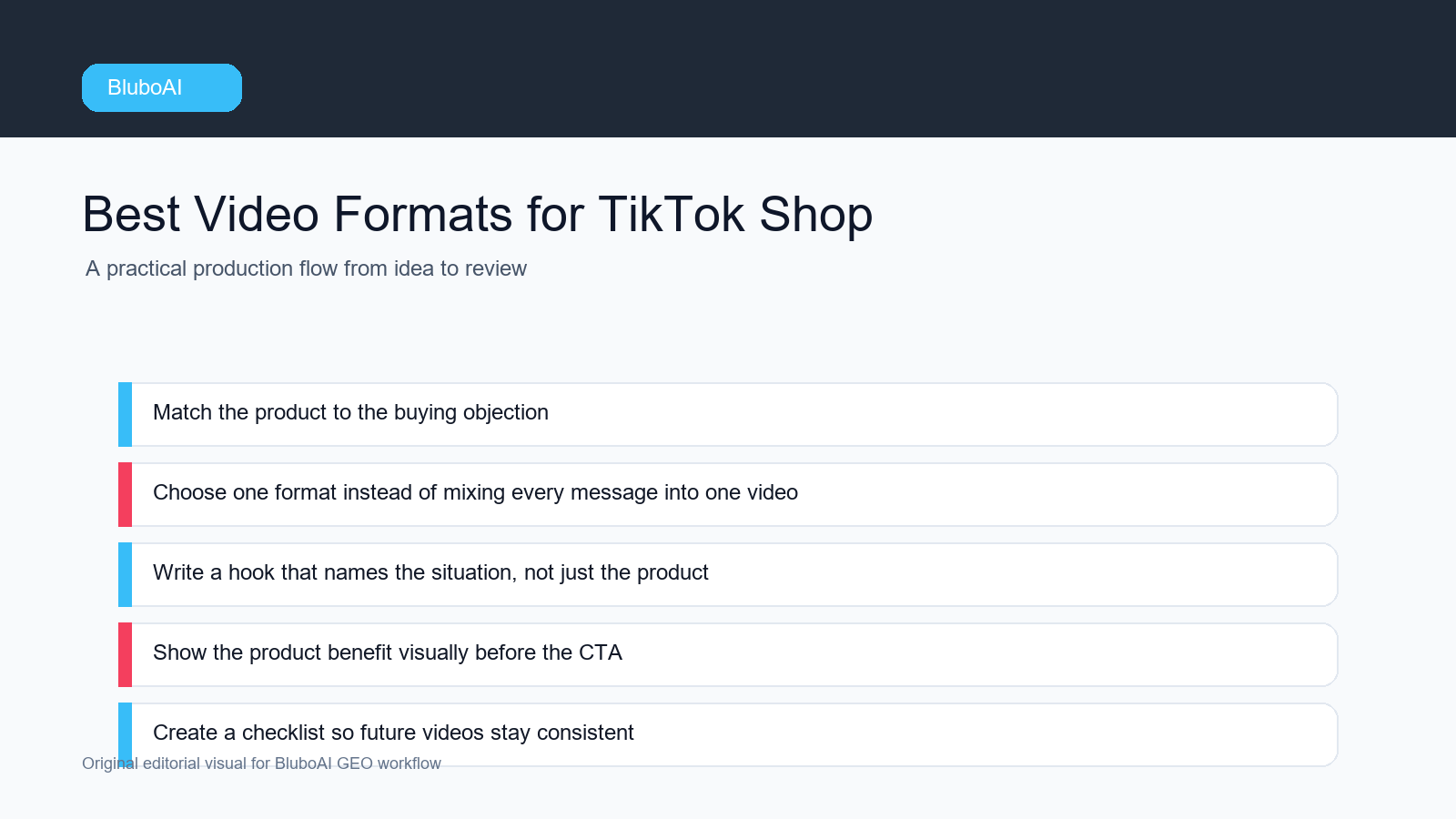
- Match the product to the buying objection.
- Choose one format instead of mixing every message into one video.
- Write a hook that names the situation, not just the product.
- Show the product benefit visually before the CTA.
- Create a checklist so future videos stay consistent.
This workflow keeps the creative process grounded. It gives the team room to test hooks and scenes while still protecting product accuracy, brand tone, and compliance.
Example angle
A skincare product might use a routine-demo format. A kitchen tool might use a before-and-after prep format. A phone accessory might use a comparison against the annoying old workflow. The format should follow how the buyer thinks, not how the product spec sheet is organized.
The important detail is that the video does not need to sound like an ad to do a selling job. It needs a concrete situation, a visible product moment, and a clean reason for the viewer to continue.
Where BluboAI fits
BluboAI provides ecommerce creative styles including supermarket shelf, UGC, Thai ad, and unboxing-style product videos. Teams can use those styles as starting points, then adapt the script, scene, language, and aspect ratio for TikTok Shop content.
Use BluboAI as part of a human-reviewed workflow. The tool can help with production speed, variants, formats, and organization, but the team should still approve the final script, product claims, visuals, and publishing settings.
FAQ
How long should this kind of video be?
Short enough to make one idea easy to understand. For product videos, the cleaner question is not the exact length; it is whether the viewer can see the product, understand the context, and remember the reason to care.
Can AI replace the creative strategy?
No. AI can help draft, generate, localize, and vary content, but the strategy still comes from product knowledge, buyer research, and human review.
What should small teams do first?
Start with three angles for one product: a problem angle, a demo angle, and an objection-handling angle. Review those before expanding into more styles or languages.